As a first time mom and long time journaler, one of my biggest priorities was documenting every tiny moment I had with my little one. It also doesn’t help that I am a highly sentimental person and that the line between keepsakes and just plain trash (yes, I need to keep that wrapper!) has been blurred beyond logical understanding.
Here are four “journalling” systems I’ve kept to record those precious first mom, first child, memories.
The Good Old Baby Book
This is the best starting point especially for first time journalers (and first time moms!) I remember how much I struggled for the first few months postpartum with just my energy and my will to be active. I didn’t actually start filling this baby book out until I was four months postpartum, but what I appreciated about it was that it took away a lot of the guilt. The guilt that I was missing something, that I wasn’t taking enough photos, that I wasn’t taking the right photos, that I’ve somehow missed out on an important memory I was going to regret not saving.
What the baby book does is it provides you with a concise guide, a filter, of what are the most crucial and important things you need to focus on. Yes, the 50,000 photos in your phone are nice to have but the 50 photos in your book is a nice comforting bundle of memories that can capture the first year of you and of your baby.
PROS
+ There are so many designs and options to choose from.
+ Already layouted with prompts—it takes the thinking away regarding what to capture and what to remember. Definitely helps with the postpartum mom brain.
+ Plug and play. Don’t need to fuss too much about decorating, doesn’t require too much of your time.
+ It gives you an idea of things you didn’t even know you should be remembering.
CONS
– There are so many designs and options to choose from.
– Rigid (Both in space and design)
– There are some pages that you won’t care for (but I just filled those up with pictures instead)
The Five Year Commitment
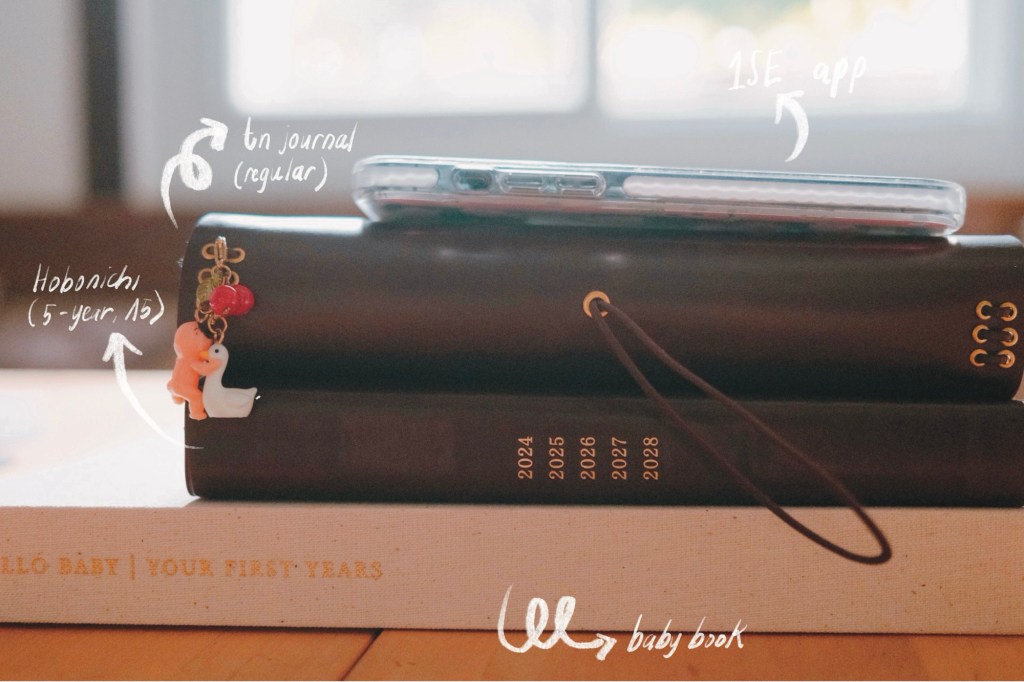
Another interesting (and exciting) way I’ve decided to memory keep is to get a myself a 5-year journal. It’s basically a journal that spans for five years where you only need to input a couple of sentences per day. There are quite a few options for 5-year journals: Leuchtturm, Midori, Sterling Ink. I personally went for the Hobonichi 5-year journals in terms of paper quality and formatting as I found that it worked best with what I was trying to achieve. Here’s an in-depth look at how I used mine.
PROS:
+ It’s very low maintenance, it can be as no nonsense as you want it to be.
+ It’s lets you see each day’s five year progression which is a really helpful feature when it comes to memory keeping. Think of facebook x years ago reminders except it’s less cringey and more private.
+ It’s “inexpensive” in a way that you are going to use this for five years. As of this year, an A5 is listed at Php 3,250. Just think of it as a 5-year journal subscription of just Php 680/year.
+ Highly archival. Once finished, you can rebound the book in a hardcover design of your choosing. Here’s how I did my first ever Hobonichi 5-year journal.
CONS:
– You’ll need to keep it alive for the next five years (and five years is a lot of time for things to change)
– To get the full effect you’ll need to commit to writing on this everyday. You could skip some days (because free will) but from experience, when the date comes round again, you’ll always wish that you filled it out then.
Scrap booking and Collages
This is probably the most fun and most creatively demanding journalling option I have on my list. It requires quite a bit more effort to get done than the other two and definitely consumes more time than necessary. The great thing about this system is that there are no rules. You can be as minimalist or as detailed as you want it to be, you can use any journal and any medium that speaks to you.
I personally use the traveller’s notebook regular inserts for this. I like the size of it and the shortness of it. I find that the inserts having a small number of pages allows me to be less intimidated with filling it up and committing to it. I can separate it by year, by month. I can skip a month if I should chose to. As a rule, I only make these creative spreads for special events that happen: family trips, birthdays, firsts—things that happen outside our ordinary schedule.
PROS
+ Highly creative mom hobby with long term pay-off. It’s like a baby book photo album pro max journal. It’s nice to think that these pages will be like a story book of you and your baby’s life. One day it would be nice to have these stories and memories to share with your child as they get older.
+ A great creative outlet (especially helpful in keeping your sanity as a first time mom)
CONS
– Time consuming! All the cutting and pasting and planning and decorating that happens can definitely take up a chunk of your time.
– Needs a lot of thinking. This can be a problem for postpartum moms as sometimes we are too tired to think of things beyond our newborns.
Just a second!
It would be a crime if I didn’t include some digital solutions for memory keeping. One app I ended up using consistently was 1SE or 1 second everyday. It’s such a low effort, big impact way to store your memories. It only requires you to record one second videos everyday and at the end of the month or year, the app can stitch everything together for you. Trust me, once you see the entire thing unfold before you, the waterworks are inevitable.
PROS
+ The app is oh so easy to use. No clunky uploading or syncing needed. It automatically files and syncs your phone photos by date and by media type, integrating it seamlessly to the app.
+ All the important functions are FREE. You can build out your one-second memories here without ever having to pay for anything. (Of course paying lets you avail of certain privileges like higher resolution exports, multiple videos per day, removing pesky watermarks on your finished compilations, etc)
+ It’s super convenient and it’s incredible being able to watch a whole year’s worth of memories in this type of curation.
CONS
– You only get one second a day. You really need to pick and choose the most important highlights of your day.
– In the long run, you run the risk of forgetting the context of that memory/one-second video. This is why I also chose to start physical journals to jot down longer, more in-depth entries.

 Notes & Nap times
Leave a comment